Videotape camera
The Running ManThe Videotape camera is the portable recording device given to Ben Richards after his appearance on The Running Man. It is central to the program’s effort to convert his flight into scheduled media content: Richards must carry it, record himself with it, and send the resulting tape clips to the Network, while the institution retains the power to edit, interrupt, and distribute what the device captures. Its importance lies in that contradiction. The camera promises Richards a voice, yet it also makes his survival legible as programming and places his speech inside the same system that hunts him.
Design and Operating Instructions
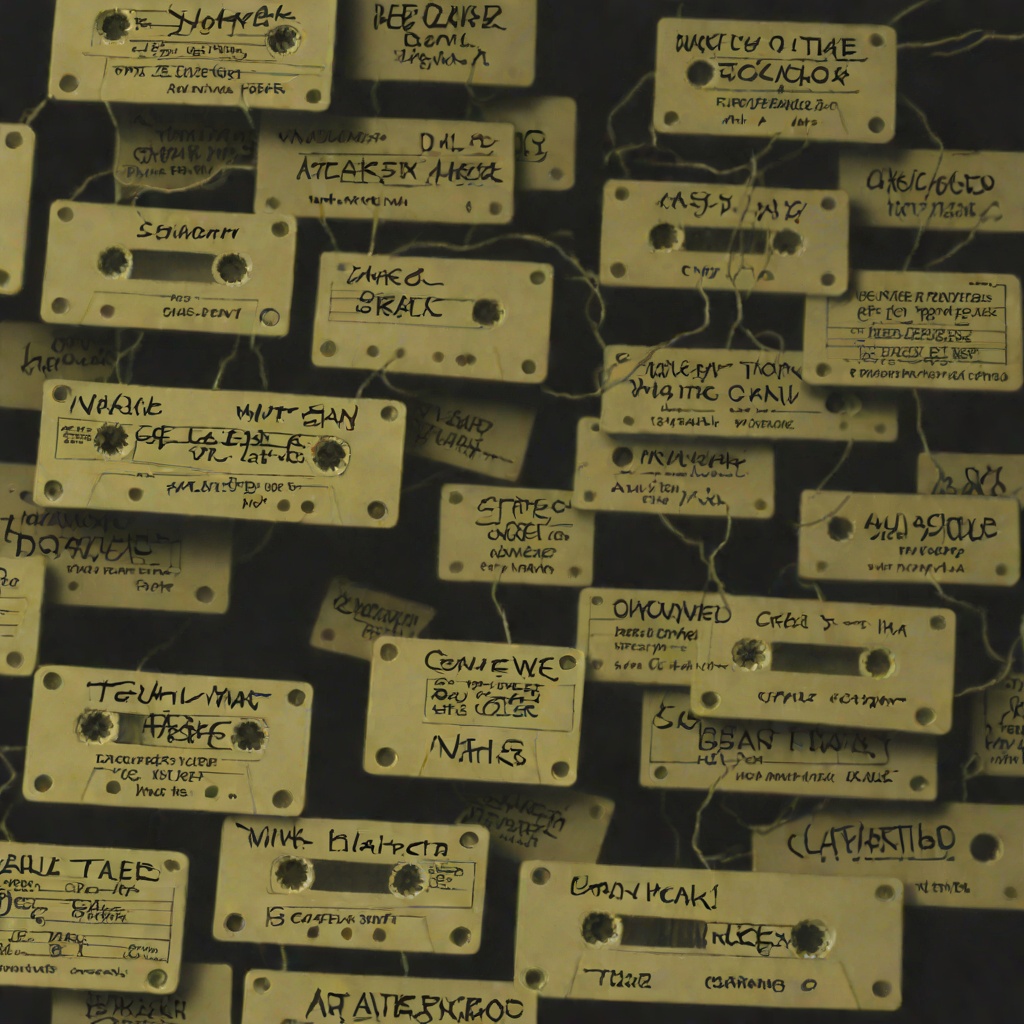
The camera is presented as a triumph of miniaturization. It is approximately the size of a popcorn box, weighs six pounds, and can fit inside a coat pocket without producing a visible bulge. Along with the machine, Richards receives sixty tape clips, each about four inches long. The equipment is therefore small enough to travel with a fugitive while still providing the Network with a regular supply of recorded material. Its physical compactness disguises the institutional burden attached to it: the object is portable, but its use is compulsory.
When Richards examines the camera in his hotel room, a metal plate marked INSTRUCTIONS gives a precise operating sequence. A tape cartridge must be pushed into slot A until it clicks into place; the viewfinder must be aligned by means of crosshairs; button B records sound together with video; and an automatic bell ejects the cartridge when the recording ends. Each recording lasts ten minutes. The instructions reduce an elaborate public spectacle to a series of mechanical gestures, making Richards temporarily resemble an operator following a machine procedure rather than a person improvising under pursuit.
The scene also exposes the camera’s uneasy domestic presence. Richards places it on the bureau beside the Gideon Bible and aims it at the bed, whose blank wall offers no obvious clue to his location. He anticipates that the Network may watch him sleep and leaves the shower running as a precaution. The device thus enters the private room not as a passive household appliance but as a possible observer. Its apparent inability to identify the hotel from the bed or background does not remove the threat; it merely shifts the contest toward concealment, sound, and the management of recorded space.
Contractual Function in The Running Man
The camera is inseparable from the rules explained to Richards by Dan Killian and the Network’s representatives. Richards will appear live on Tuesday night, while later programs will combine tapes, films, and live tricasts whenever possible. The producers may even interrupt scheduled broadcasting when a contestant is close to his personal Waterloo. The camera supplies the recorded material that allows the hunt to continue as a recurring broadcast rather than a single live event.
Its use is enforced through payment. Richards receives forty-eight hundred New Dollars as running money on the assumption that he can evade the Hunters for forty-eight hours, and the larger rules promise one hundred New Dollars for every hour he remains free, with the unspent balance refundable if he falls early. Against that financial structure, the camera imposes a daily quota: two clips must be deposited each day, and failure to do so constitutes legal default of payment. Recording is therefore not merely a means of self-expression or proof of continued life. It is labor performed under contract, with the fugitive’s body and testimony converted into deliverable units.
The Network describes the clips as easy to transmit. Richards can drop them into any mailslot, after which they will be delivered express for editing and airing that night. This arrangement combines obsolete-looking physical circulation with highly coordinated mass broadcasting: a small cartridge enters ordinary postal infrastructure and returns as part of a program consumed by millions. The camera’s recordings are not stored for private memory. They are manufactured for rapid institutional processing, and the gap between mailing and broadcast becomes another form of control over what Richards can say and when the public can hear it.
The larger rules make the object part of a market in visibility. The Network pays one hundred New Dollars for a verified sighting of Richards and one thousand for a sighting that results in a kill; independent cameramen receive ten dollars a foot and upward for footage. The camera consequently belongs to an ecology of competing images: the contestant’s own clips, audience reports, professional broadcasts, and independently filmed material all feed the same spectacle. Richards’s survival is valuable not only because it produces suspense, but because every possible view of him can be priced.
Recording, Editing, and Censorship
Richards uses the camera to address people whom the Network’s polished broadcast usually excludes: residents of the Developments and ghettos, inhabitants of cheap high-rises, cycle gangs, unemployed people, and young people arrested for crimes they did not commit. Stacey helps send two clips through a mailbox on Commonwealth Avenue, while Richards allows Ma to hold the camera in the back bedroom after covering the window and furniture. The care taken with the room shows that recording is also a logistical operation. A message requires a concealed location, a helper, a camera operator, and a route into the postal system.
The resulting broadcast briefly reverses the camera’s intended purpose. Richards’s image begins speaking directly to a mass audience about a monstrous conspiracy and about people whose ability to gather and communicate is being restricted. Yet the sound suddenly collapses into squeaks, pops, and gargles, then disappears while his mouth continues moving. The failure is not simply a technical inconvenience. It demonstrates that the recorded image can survive while its political meaning is removed. The camera preserves a visible body, but the Network controls the audible body of the message.
This mutilated clip clarifies the difference between recording and communication. Richards can operate the machine correctly, send the cartridge through the required channel, and appear on the screen, but none of those steps guarantees that his statement will reach the audience intact. The camera gives him a material means of testimony while the broadcast system retains editorial sovereignty. His image becomes evidence of suppression even as the suppression prevents the original speech from circulating.
Relation to the Live Hunt
The camera’s recordings operate beside, and sometimes against, live television. During the televised introduction, Bobby Thompson presents a retouched portrait of Richards as an urban monster: the hidden-camera image deepens his eyes, lowers his forehead, shadows his cheeks, and gives his mouth a curled, jeering expression. The resulting figure is described as an uptown apartment dweller’s boogeyman, and the audience is urged to remember his face because a verified sighting or a killing will earn money. The still image and the moving camera footage therefore serve different stages of the same framing process: one constructs the wanted identity, while the other offers controlled opportunities for Richards to contest it.
The apparatus also participates in a chain of cameras surrounding the later confrontation at the jetport. Richards’s threat to carry twelve pounds of “Black Irish” explosive, fitted with a General Atomics Imploder ring pulled halfway out of cock, is recorded by cameras that reel and crank while flashbulbs pop. The press hesitates because the five hundred million viewers create psychic pressure: the event is both a physical standoff and a spectacle whose reality is being tested before a worldwide audience. Amelia Williams’s appeal and the surrounding action are likewise sent out on a live feed. In this setting, the handheld camera is not an isolated object but one component in a dense system of surveillance, reporting, and public synchronization.
The aftermath shows the power of that system without requiring the camera itself to be present in every frame. Two troopers watch the aircraft accelerate down the runway, while the broader event has already been made available to audiences through cameras and live transmission. The machine’s significance is therefore infrastructural. It helps transform escape into a sequence that can be replayed, edited, interrupted, and remembered, while live cameras make the same escape a shared public crisis.
Material Presence and Narrative Significance
For most of the story, the camera is valuable because it seems unobtrusive: it fits in a coat pocket, records for ten minutes, and can be fed into a mailslot. Its material presence becomes unmistakable when Richards handles it in moments of danger or uncertainty. It is a six-pound obligation carried by a hunted man, a device that must be maintained even while he is attempting to remain unseen. The object’s weight counters the Network’s rhetoric of effortless modern technology; what is called a triumph is also another burden attached to Richards’s body.
The camera also makes the boundary between public performance and private existence unstable. It can point at a bed, preserve the silence of a room, or transmit a political address, but all such images are liable to become network property. Even the possibility that someone may be watching Richards sleep changes the meaning of rest. The machine does not merely document the chase; it reorganizes the spaces in which the chase occurs by making concealment, background, sound, and timing part of a media calculation.
Near the end of the supplied sequence, Richards closes his eyes and repeatedly sees the glossy eight-by-ten photograph associated with his public representation, then opens his eyes and turns on the Free-Vee, where Killian appears. The camera is not the photograph or the television, but it belongs to the same circuit of images that has made Richards simultaneously visible and misrepresented. Its deepest narrative function is to expose how the Network’s spectacle is assembled from portable recordings, postal delivery, editorial intervention, live feeds, and audience response. The device offers a technical route from the fugitive to the public, yet the route is never outside the institution that owns the broadcast. In that sense, the Videotape camera is both Richards’s instrument of resistance and the Network’s most intimate means of continuing the hunt.